
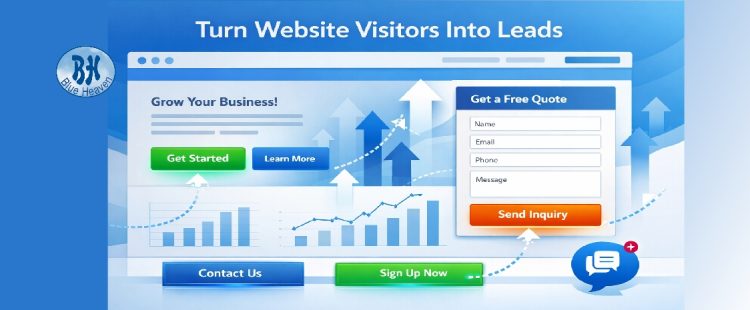
Website Conversion & Lead Generation: Turning Visitors into Business Opportunities
Getting traffic to a website is an achievement.
But traffic alone does not grow a business.
What drives growth is conversion — the ability of a website to turn visitors into inquiries, leads, and sales conversations.
Many businesses struggle not because their website lacks visitors, but because it lacks conversion clarity. Visitors arrive… browse… and leave without taking action.
This article explains how website conversion and lead generation actually work, what blocks them, and how businesses can build websites that consistently generate leads.
⭐ 1. What Website Conversion Really Means
Website conversion is any meaningful action a visitor takes that moves them closer to becoming a customer.
Conversions can include:
-
Submitting an inquiry form
-
Requesting a quote
-
Booking a call or appointment
-
Clicking a WhatsApp or call button
-
Downloading a brochure, guide, or checklist
A high-converting website does not push visitors.
It guides them naturally toward the next logical step.
⭐ 2. Why Most Websites Fail to Generate Leads
In most audits, lead generation fails due to a combination of small but critical issues.
Common conversion blockers:
-
No clear call-to-action (CTA)
-
Too many CTAs competing for attention
-
Confusing navigation and page flow
-
Lack of trust signals
-
Poor mobile experience
-
Slow page load times
-
Forms that ask too much, too early
When visitors are unsure what to do next, they do nothing.
⭐ 3. The Conversion Framework: From Visitor to Lead
Effective conversion follows a simple progression:
Attention → Clarity → Trust → Action
If even one stage is weak, conversions drop.
Attention
Your page must immediately communicate:
-
What you offer
-
Who it’s for
-
Why it matters
Clarity
Visitors should never guess:
-
Where to click
-
What happens next
-
How to contact you
Trust
Trust is built through:
-
Testimonials and reviews
-
Certifications, credentials, and compliance
-
Clear business information
-
Transparent processes
Action
Every page must guide the visitor to one primary action.
⭐ 4. Calls-to-Action That Actually Work
A CTA is not just a button.
It’s a decision prompt.
Effective CTAs are:
-
Clear (“Request a Quote”, “Book a Call”)
-
Visible (above the fold and repeated logically)
-
Relevant to page intent
-
Low-friction
Examples of strong CTAs:
-
Get a Free Consultation
-
Request Pricing Details
-
Talk to an Expert
-
Get a Website Audit
-
WhatsApp Us for Quick Response
Weak or generic CTAs dilute conversion potential.
⭐ 5. Landing Pages vs Regular Website Pages
One of the biggest conversion mistakes is sending all traffic to the homepage.
Landing pages are built to:
-
Focus on one audience
-
Address one problem
-
Offer one solution
-
Drive one action
They remove distractions and improve lead quality.
High-performing businesses use multiple landing pages, not one generic site for everyone.
⭐ 6. Forms, Chatbots & WhatsApp: Lead Capture Tools
Lead capture should match user comfort.
Common tools:
-
Short inquiry forms (3–5 fields max)
-
Click-to-WhatsApp buttons
-
Chatbots for quick qualification
-
Appointment booking tools
The easier it is to reach you, the more leads you receive.
⭐ 7. Mobile Conversion: Where Most Leads Are Lost
For many Indian businesses, 70–85% of visitors are on mobile.
Common mobile conversion issues:
-
Buttons too small
-
Forms hard to fill
-
CTAs below the fold
-
Slow loading pages
A mobile-first conversion approach is no longer optional.
⭐ 8. Lead Quality vs Lead Quantity
More leads are not always better.
A strong conversion strategy focuses on:
-
Attracting the right visitors
-
Asking the right questions
-
Filtering low-intent inquiries
-
Creating meaningful conversations
Quality leads save time, money, and effort.
⭐ 9. Measuring Conversion Performance
Conversion improvement requires measurement.
Key metrics to track:
-
Conversion rate per page
-
CTA click-through rate
-
Form completion rate
-
Drop-off points
-
Source-wise lead quality
Data tells you what to fix first.
⭐ 10. Conversion & Lead Generation Is a System
High-performing websites don’t rely on luck.
They rely on:
-
Clear structure
-
Strategic CTAs
-
Trust-building content
-
Optimized landing pages
-
Consistent testing and improvement
Conversion is not a one-time activity — it’s an evolving system.
⭐ 11. Want a Free Website Conversion Audit?
If your website gets visitors but not enough inquiries, a conversion audit can reveal why.
A free audit will show:
✔ Where users drop off
✔ Which CTAs are underperforming
✔ Mobile conversion gaps
✔ Trust signals that are missing
✔ Quick wins to increase leads
Comment “Conversion” or contact via webpromotionservices.net
🔚 Final Thought
Traffic brings attention.
Conversion creates opportunity.
Your website should not just be visible —
it should be action-driven.